
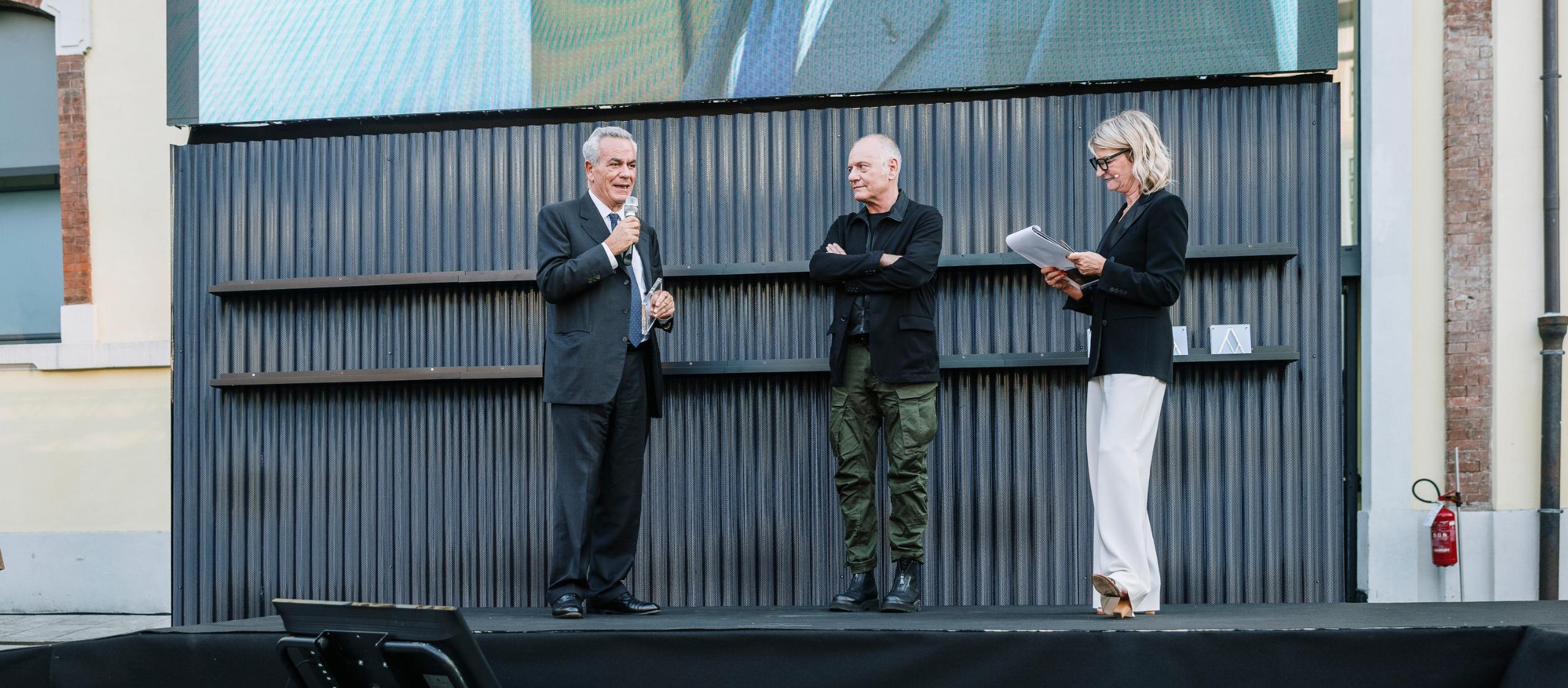
Founded by Antonio Romano in 1980, Inarea reflects the vision of one of the leading figures in Italy’s design culture. Over the years, he has shaped the identities of companies and institutions that have become part of the country’s collective memory. Aci, AC Milan, Anas, Autostrade per l’Italia, The Venice Biennale, Cgil, Cisl, Confcommercio, Confindustria, Coni, Enel, Eni, Frecciarossa, Ilva, Italo, Maxxi, Rai, Snam, Tim, Treccani, Webuild, …to name just a few—spanning decades of economic, technological and social transformation that have redefined the relationship between brands, media and people. The XXIX ADI Compasso d’Oro Career Achievement Award recognises not only the value of his work, but also his ability to interpret design as a cultural tool—one that understands the present, anticipates change and shapes a vision of the future.
What does it mean to receive the Compasso d’Oro for lifetime achievement?
It is the recognition of a path in which design has always been understood as a means of giving value to things, both material and immaterial: the end is always identity. A better world is also a more beautiful world. When art stopped placing beauty at its centre, design took over that space: first through function, then by creating relationships, empathy, belonging.
A career that runs parallel to the evolution of contemporary brand identity.
In the Seventies, advertising opened up a new world for products. In the Eighties came the idea of relationality: we understood that everything that exists communicates. At the time, companies were multiplying their marks — a brand for every product. We worked in the opposite direction, towards a single identity reference capable of representing many elements, however different from one another. With CGIL, for example, that red square became a container able to hold together very different stories. It was a cultural shift: not celebrating what belongs to us, but what we belong to.
Today, in the age of social media and online communities, this question of belonging seems even more central.
Certainly. A brand’s success depends on how many people feel it as their own. People want to belong to worlds in which they recognise themselves, and algorithms now amplify that dynamic continuously. This is why the “purpose” underlying a brand identity has become decisive: what counts is not only what you do, but why you do it.
What were the turning points in Inarea’s history?
After CGIL came Finmeccanica, Enichem and ILVA, which gave us credibility. The RAI rebranding was then a decisive step, because that project entered people’s homes. You only had to say “the butterfly people” and everyone knew who we were. But I could just as well name CartaSì, equally fixed in everyone’s memory, because we turned “Servizi Interbancari” into a simple, familiar name, suited to a society in which digital payments were becoming part of everyday life; or La Biennale di Venezia: an almost provocative project, an unorthodox and disruptive identity for a historic institution.
That RAI mark is still alive in the collective imagination, even though it was replaced more than fifteen years ago. Why?
Because it was a polysemic form: a mark able to generate several readings and several meanings at once. From a distance you saw a butterfly; then you discovered two profiles facing each other — the symbol of dialogue and of moving beyond broadcast television. In those years we had already sensed that the “one to many” model would come to an end, and that digital would turn everything into a more interactive relationship, moving to one to one and many to many.
Which crises most changed the way a brand is represented?
The economic crisis, which in Italy was compounded by the political one of Tangentopoli, hit us hard: we were an independent firm and we went through extremely difficult years, yet we managed not to lay off a single person. Later, the Lehman Brothers crisis radically changed the global market. Until then, the internet had opened enormous possibilities even to independent practices like ours: we received enquiries from all over the world, particularly from emerging markets that saw one of our projects online and contacted us directly. We had also built an international network of partners, but the financial collapse made those flows vanish, and the market concentrated around the large multinationals of branding and strategic consulting. Meanwhile, digital was already changing the very language of the brand: a change that happened almost in silence, like a snowfall you notice only when you open the door and find the whole landscape transformed. Touchpoints became immaterial, increasing the weight of words and of the interface. In the digital world, changing an identity no longer means replacing signs, physical materials or sales networks, but updating interfaces, applications and online environments. Big Tech set a new rhythm of change, and the life cycle of brands has shortened dramatically.
Which historical events contributed just as much to redefining the representation of the brand?
The 11th of September 2001 shattered the happy illusion of globalisation that had followed the fall of the Berlin Wall in 1989, carrying us into today’s post-globalisation. In that passage, the promise of linear integration and of a single world market collided with the reality of a profound geopolitical fragmentation and the return of economic and cultural barriers. Identity moved from being a concept of belonging rooted in shared values to an expression of otherness and radicalisation, shifting progressively towards the culture of the body and of pure aesthetic representation. In brand identity, this scenario marked the decline of the static “heraldic” symbol in favour of the new rules of “liquid” branding: one no longer guards rigid, specific values, but governs flexible languages and narratives, adapted to different audiences.
Today artificial intelligence can create a logo in a matter of seconds. What is left of the designer’s craft?
AI is a magnificent instrument, provided we do not put a gun in the hands of children. Artificial intelligence opens up enormous possibilities: it lets us save time and reach explorations that, by traditional methods, would cost us far greater effort. But it does not replace sensibility. I continue to believe that a project works when it generates an emotional impact and then finds a rational confirmation. Passion remains a uniquely human prerogative.
Who is a good communicator today?
Someone who manages to hold on to an authentic “purpose”. Communication is no longer a vertical transmission: the passive spectator no longer exists, and the only thing that works is the creation of belonging. In other words, the winner is the one who builds communities in which people feel welcomed and represented. And this is why it is urgent to reaffirm design as a strategic and economic driver for our country. We must take it out of the logic of the ephemeral and of purely commercial trends and bring it back to the deeper plane of design culture, valuing it as a collective heritage. Because if identity is the substance that binds us, it is through design that we judge the world.