
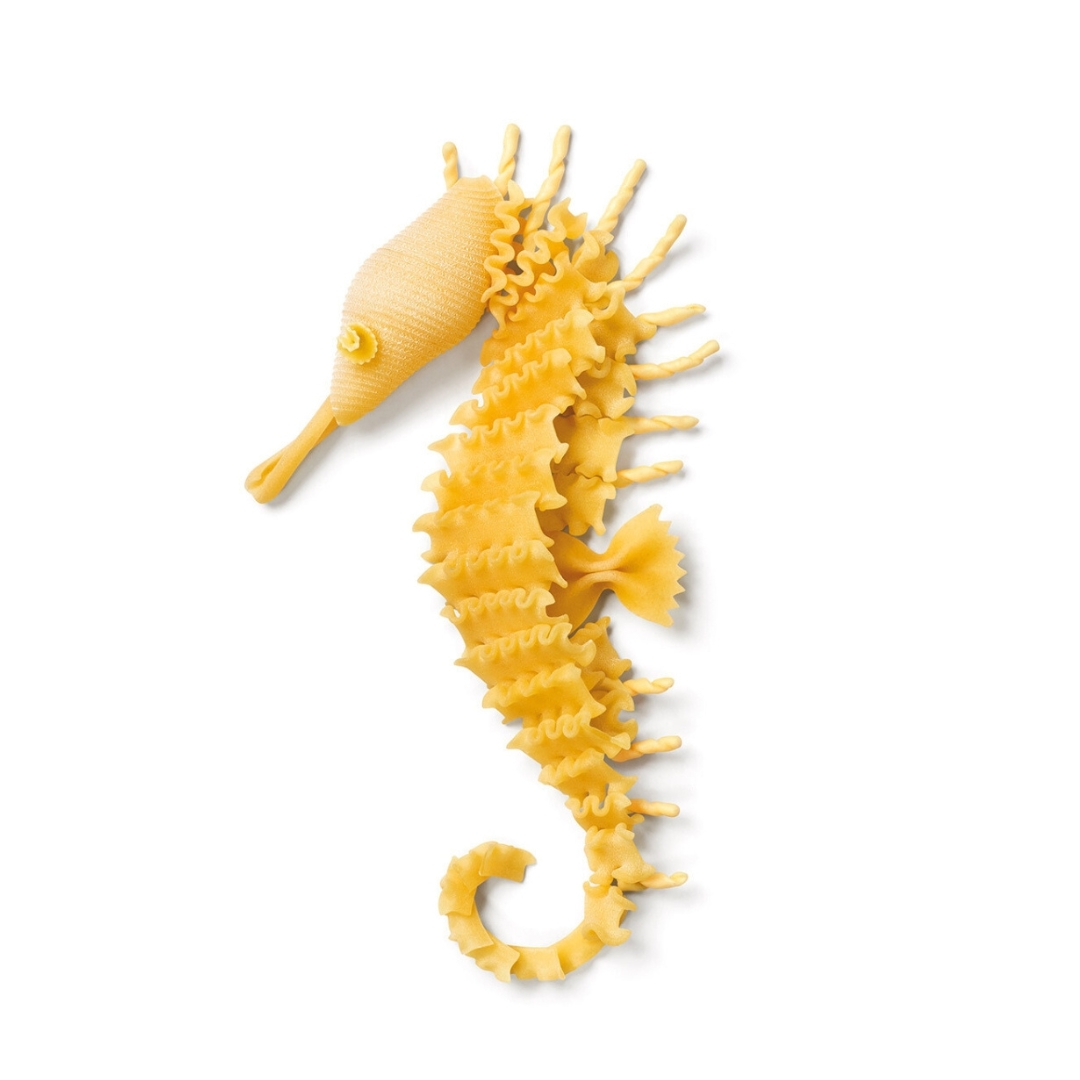
With a poetic and ironic language, the Inarea Calendar has, for over thirty years, traced the themes of our present—such as attention to sustainability—while interpreting everyday attitudes, from our relationship with pets to the tools of our trade, set against the backdrop of an ongoing process of digital dematerialization.
Yet, despite its ability to embody synthesis and lightness of thought, the Calendar entails a rather substantial preparation process: each edition involves around seventy preparatory sketches, about thirty semi-final drawings with indications of the materials to be used, over twenty mock-ups to be photographed, and as many photographic shots with post-production (clipping, retouching, two or three layout proposals, and print proofs), followed by packaging and shipping.
Work on the theme begins at the start of the year, with the Calendar released at its end. A close-knit team of long-standing collaborators—around ten designers, consistently the same—is involved, as entering the complexity of the project is not immediate. If, in 1991, the first Calendar was sent to around 1,500 recipients, by its twenty-fifth edition in 2016 it had reached sixteen thousand addresses worldwide.
Irony and surprise: the Calendar’s key ingredients
The Calendar pursues an uncompromising quality, to which its format (48.5 × 34 cm), the white background, and letterpress printing all contribute. “The element of surprise is its defining feature,” notes Monica Solimeno, Project Director at Inarea, who has overseen the project for more than fifteen years.
“The unexpected effect emerges from a semiotic play and from the decontextualization of everyday materials in the creation of the subjects. The figures take shape either through a formal correspondence with these materials or through the composition of multiple elements. The more essential the form, the more effective the result.
This linguistic code stems from the systematization of a way of communicating—already visible in the 1980s—based on the organization of images through the abstraction of ready-mades.
The Calendar expresses a capacity for synthesis, essentiality, and attention to detail that lies at the very core of Inarea’s DNA and its interdisciplinary approach (defined as plural design). For instance, despite a different visual outcome, the essential form of the tulip in the logo of Sara Assicurazioni represents a similar use of both metaphor and the abstraction of the sign, as well as a comparable departure from the conventional language of that field.”
How might the Calendar project evolve?
Considering that, over more than thirty years, the Inarea Calendar has built a broad base of supporters, is it possible to reinterpret this project through new tools without betraying its identity? If mock-ups are still made by hand, can artificial intelligence support this phase or facilitate the conceptual layout stage?
“Some years ago,” continues Solimeno, “there was an attempt to create objects such as cups or placemats using some of the Calendar subjects, but these are conceived on a white background, on high-quality paper, and through high-level letterpress printing.
Transferring them onto plastic surfaces did not produce the same result. The only extensions beyond the Calendar itself have been notebooks and shopping bags, where it was possible to preserve the same level of quality precisely because they are paper-based.
More recently, an app has been developed that showcases the work of all 34 years. At the moment it functions as an image repository, but it has the potential to create an engaging interaction with users, introducing a reciprocal and bidirectional dimension not possible on paper—thus also addressing a younger, device-oriented generation.
More than three decades of work on the Calendar have generated a body of hundreds of archival images, including sketches, discarded subjects, mock-up work in progress, and both analog and digital photographs. This is a resource with significant creative potential, where the underlying irony can be preserved in a timeless play.” Once again, everything is already there, available for new associations and interactions.