
Even in the educational sector, branding has become a strategic factor. In an increasingly competitive and globalized landscape, building a strong and recognizable brand identity helps universities stand out, attract students, and position themselves consistently within the education system and the job market.
What is brand identity in the educational sector?
Everything that doesn’t need to be explained is branded. Studying at Harvard, for example, means presenting yourself with a remarkable background — the university’s reputation becomes a true guarantee for its graduates. In other words, brand is reputation. The urgency to build a brand in academia stems from a time of change — both in how education is delivered, with the rise of online learning opportunities, and in how students approach their studies. The declining birth rate means institutions must make up for lower domestic enrollment by attracting international students. As competition between universities becomes inevitable, it is essential to present oneself in the best possible way. Building a strong and recognizable brand identity helps institutions stand out and position themselves consistently both within the educational system and the job market.
Let’s start with the experience at Sapienza University of Rome. What were the main challenges?
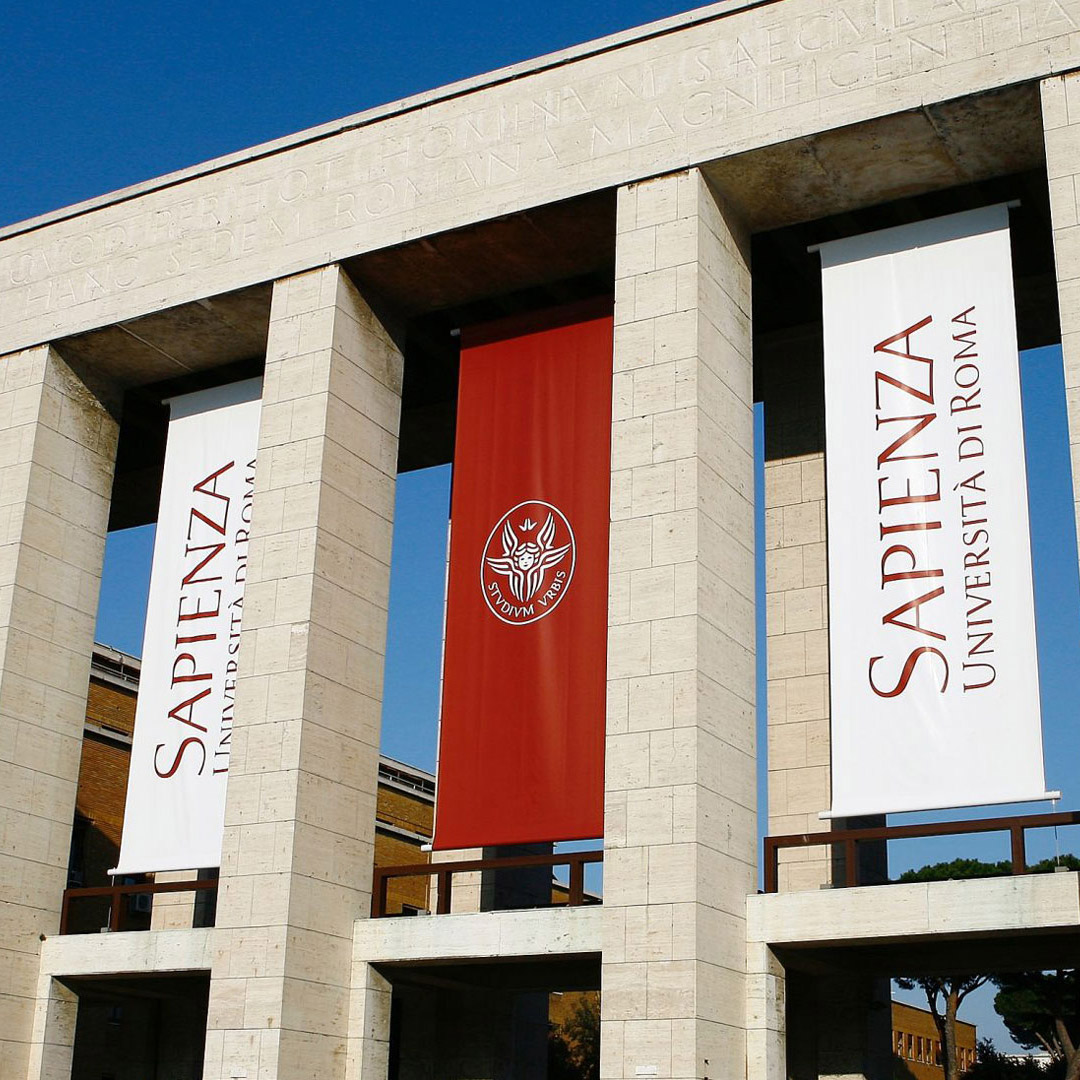
The project for Sapienza University of Rome, launched in 2006, was one of the most complex due to its scale and historical depth. We’re talking about a university with over 150,000 students and a legacy spanning seven centuries. The goal was to build a strong identity capable of uniting many different entities — such as schools and departments — which were often disconnected from each other. The intervention took place during a reform that replaced the traditional faculty-based system. We developed a rigorous brand architecture: Sapienza (without “la”) was established as the master brand, while departments and schools were identified typographically only, using custom-designed typefaces and eliminating symbolic references. This decision initially sparked significant criticism. The color purple was chosen instead of the conventional academic blue to evoke the colors of Rome and emphasize the university’s connection to the city. The tagline “Il futuro è passato qui” (“The future has passed through here”) captures the university’s historical value and cultural heritage.



Public or private, is there a difference in how a brand is built?
The method is the same: analysis, strategy, vision. What changes is the specific context. Public universities often need to rationalize a historical legacy, while younger private institutions focus on legitimacy and attractiveness. But today, both public and private universities face similar challenges.
LUISS, for example, has successfully highlighted its role as a place of opportunity and global connections, strengthening the trust of students and families. Inarea’s relationship with the university began in 2017 with the celebrations of its 40th anniversary and later developed into a full rebranding project. The result was a clear and consistent positioning, supported by continuous investment in its international network.
Similarly — though with different outcomes — LIUC (Università Cattaneo) focused on reinforcing its identity as a university rooted in the industrial world, closely connected to its region, and oriented toward the future.



How important is experience — especially digital user experience — in shaping brand perception?
A lot — because today, the experience begins well before enrollment. The website, informational materials, and digital navigation all need to be consistent, clear, and engaging. User experience is central, especially for universities offering a wide range of programs. It’s during this initial phase that the emotional connection with the prospective student is built. The differentiating element might be history, as in the case of Sapienza, or a forward-looking vision, like OPIT — a digital-native institution that positioned its world-class faculty as brand ambassadors to attract students. In any case, the brand must inspire trust, be memorable, and remain recognizable across all touchpoints — from digital platforms to physical spaces.
In which direction is brand identity heading in the educational world?
It’s becoming increasingly systemic. A brand is no longer just a logo or a color — it’s a way of governing identity. It’s what builds meaning in people’s minds. With artificial intelligence and digitalization reshaping the landscape, we may soon see new players enter the scene — imagine if Amazon decided to found a university: the strength of its brand alone would be a major competitive advantage. That’s why, now more than ever, we need a broad vision and a narrative that can speak to people’s emotional intelligence. Because a strong brand in the world of education doesn’t just tell you what an institution is — it tells you where it can take the people who choose it.